The journey atlas
Across the Mediterranean
Opening essay
Empires, Ruins & Something on a Stick
There is something extraordinary about standing before the Great Pyramid of Giza and realising it was already more than two thousand years old when Rome reached its imperial height. The Greeks admired Egypt; the Romans conquered it; later Islamic and Ottoman rulers inherited a landscape whose monuments were already ancient.
At Petra, Nabataean merchants prospered through desert trade, carving monumental facades whose architectural vocabulary included Hellenistic influences. In Athens, the Parthenon recalls a classical world whose ideas spread far beyond Greece. Rome absorbed and transmitted those ideas across the Mediterranean; its eastern imperial tradition endured at Constantinople long after the western empire fell.
Hagia Sophia was completed in AD 537 for the Byzantine emperor Justinian. After the Ottoman conquest of 1453, the great church became a mosque: a remarkable monument to both continuity and transformation.
Across the western Mediterranean, Marrakech and Fez reveal the artistic and intellectual connections of the Islamic west. In Córdoba, Seville and Granada, the architecture of Al-Andalus survived political conquest and continued to shape Christian royal spaces. The mosque-cathedral of Córdoba and the Alhambra make that history tangible.
Portugal carries the story out into the Atlantic. Maritime trade connected distant continents and helped transform European markets and kitchens. Tomatoes and chillies from the Americas arrived much later than the classical empires, yet became integral to cuisines that now seem timeless.
And everywhere there is food: Greek souvlaki, Marrakech tanjia, Fassi pastilla, Andalusian pinchos morunos, Porto bifanas and Lisbon custard tarts. Not all are ancient recipes; their ingredients and traditions record centuries of exchange. The monuments tell us who held power. The markets tell us how people lived.
Empires rise. Empires fall. But somewhere, someone is still grilling meat over charcoal.
Petra · February
The city at the end of the cleft
At the narrowest bends of the Siq, the walls hide everything ahead. A few more steps bring a single pale column into view. Only as the passage opens does the rest of the Treasury appear: two tiers of classical architecture cut straight into rose-coloured sandstone. The dark edges in the photograph are the sides of the passage you have just walked through.
There is another piece of Nabataean craftsmanship down at knee height. Water channels follow the sides of the Siq towards the city. Petra stood on caravan routes linking Arabia with the Mediterranean, and every trader, pack animal and resident needed water in an arid valley. The façade tells you what Petra could afford. The channels help explain how a city could live here at all.
“I’m expecting a dramatic reveal at the end of the Siq. The Nabataeans apparently understood the value of making visitors walk a kilometre before showing them the good bit.”
Back to contentsCairo & Giza · February
Giza — Four Thousand Years of History and a Bloody Good Sandwich
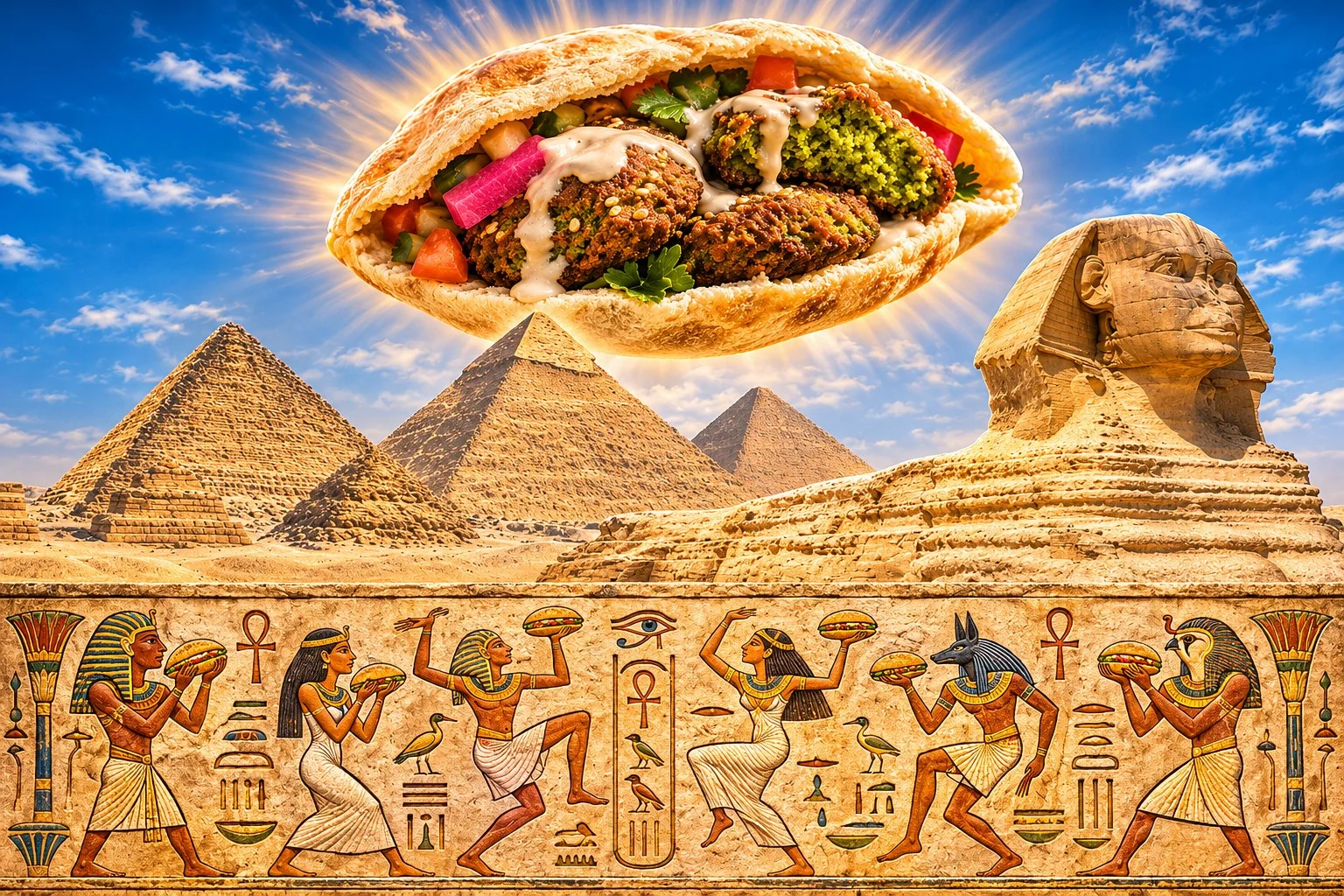 Illustration · A ta’ameya sandwich on a pharaonic scale
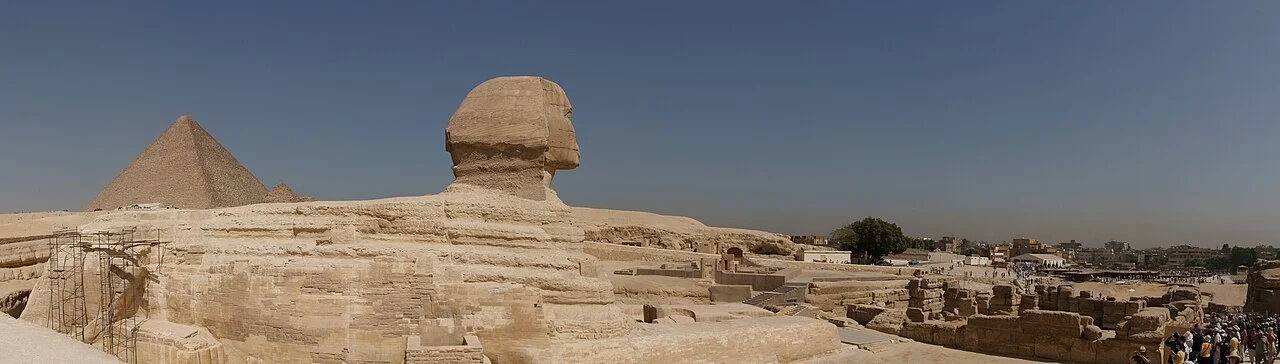 The Great Sphinx and Khufu’s pyramid on the Giza plateau. · kallerna · CC BY-SA 3.0
The plan is to look properly at the pyramids and Sphinx, take a few photos and politely decline any camel rides that come my way. Then I want a bloody good ta’ameya sandwich: crisp Egyptian fava-bean falafel tucked into baladi bread with tahini and pickles.
The Great Pyramid is easy to recognise from its outline. The Great Sphinx takes a little longer to read. From the side, follow the long back towards the haunches, then the forepaws stretching out in front. What looks from a distance like a statue set down on the plateau was largely carved from the limestone already there. The builders cut the ground away and left a lion behind.
The pyramid in the panorama belongs to Khufu. The Sphinx stands beside the valley temple of his son Khafre, whose pyramid rises on slightly higher ground. The evidence points to the Sphinx being carved during Khafre’s reign. Seen together, the two monuments in the photograph belong to successive chapters of a royal family.
Look up towards Khafre’s summit for the surviving cap of dressed stone. It gives a sense of how different the plateau once looked, when smooth casing caught the sun and the rough courses familiar from photographs lay hidden underneath. That little patch near the top is worth a second look before heading back to Cairo.
If the sandwich stall is as quick as I’m imagining, I already know what I’ll say.
“The ancient Egyptians spent centuries perfecting the art of pyramid-building. My ta'ameya sandwich was ready in 98 seconds. Frankly, I know which civilisation had its priorities sorted.”
Back to contentsAthens · February
Walk from a king’s shops to Caesar’s market
Finish a sesame koulouri and coffee below the Acropolis. On the ascent, look up to the little Temple of Athena Nike. A Mycenaean stronghold guarded this approach long before the temple stood here. The Persians burned the sanctuary in 480 BC. The Parthenon you see above you belongs to the city that rebuilt after the fire.
Come down to the Ancient Agora and step under the long roof of the reconstructed Stoa of Attalos. In the second century BC a king of Pergamon gave Athens a market hall with two storeys of shops. Walk east to the Gate of Athena Archegetis. Beyond it is another market courtyard, paid for by Julius Caesar and Augustus. Look back towards the old market. A shopper could walk from a Hellenistic king’s gift to Rome’s investment in the course of buying supper.
Around Monastiraki, order bread, olives and grilled fish for lunch. These are flavours an ancient Mediterranean market-goer would recognise. Keep the lemon-dressed fish and your later souvlaki in the present day. If your feet have had enough, the gate is a good place to finish. With another stretch in you, walk to Hadrian’s Library, then back along the Roman Agora to the Ottoman Fethiye Mosque. For sunset, pick up a pork kalamaki and head for Philopappos Hill.
“A hill full of philosophers and I’ll still be thinking about the next souvlaki.”
Back to contentsNafplio & the Argolid · February
The governor’s last doorway
Start with cheese bougatsa and coffee on Nafplio harbour. Look out at Bourtzi, then turn inland towards Palamidi. Those gun positions belong to the centuries when Venice and the Ottomans fought over this anchorage. At Mycenae the scale of power is different. Walk between the massive stone jambs of the Lion Gate, then visit the beehive tomb known as the Treasury of Atreus. The name comes from legend. The stone vault is what a Bronze Age palace society actually left you.
Give Ancient Corinth the longer stop on the drive if time allows. Stand in the Roman forum facing the columns of Apollo’s temple. Those columns already stood when Philip II of Macedon brought Greek states into his league here. Rome sacked Corinth in 146 BC. A century later Julius Caesar founded a colony on the site. Its builders aligned their forum with an older Greek colonnade. From the square, follow the Lechaion Road towards the Peirene fountain and imagine fetching water while the shopkeepers opened up. The most eloquent thing Rome left here might be the Greek temple it let stand.
At a village taverna after the ruins, ask for lentil soup, bread and olives if they’re on the menu. It’s a way to taste the staples behind those grand civic buildings. Save Epidaurus for its own outing from Nafplio. Sit in the theatre first, then walk through the sanctuary of Asklepios where people came hoping to be healed. Back on the promenade, collect a hot skewer before sunset and take the seat facing Bourtzi. If the day ran long, the harbour gives you the Venetian chapter from a bench.
“The Venetians picked a fine spot for a fortress. I’m hoping they left somewhere at the bottom to buy breakfast.”
Back to contentsMarrakech · February
From an Almohad minaret to supper in the square
Start at the riad with msemen, honey and mint tea, then walk towards the Koutoubia. The Almoravids founded the city and the Almohads left the minaret as a landmark of a capital whose reach extended into al-Andalus. Give El Badi and the Saadian Tombs their own chapter in your head: a later dynasty built that palace and buried its rulers nearby. Bahia belongs to a later Marrakesh again.
Try tanjia marrakchia at lunch and ask how the cook prepared it in its clay pot. At dusk, return past the Koutoubia to Jemaa el-Fna for lamb brochettes or kefta.
“I’ll know I’ve found the right tanjia when I start resenting the invention of sharing plates.”
Back to contentsFez · February
A school in a street full of ovens
Enter through Bab Bou Jeloud and follow the smell of bread towards Bou Inania Madrasa. Inside, look closely at the carved plaster, cedar and tilework. Back in the lanes, the next thing to find is a pastilla.
“I’d trust the bread to find its way home from the communal oven before I’d trust myself to find my riad.”
Back to contentsCasablanca · February
Casablanca
After the lanes of Fez, the Moroccan chapter turns towards the Atlantic. Casablanca gives the journey a different horizon.
Back to contentsMálaga & Caminito del Rey · February
The workers’ path above the Guadalhorce
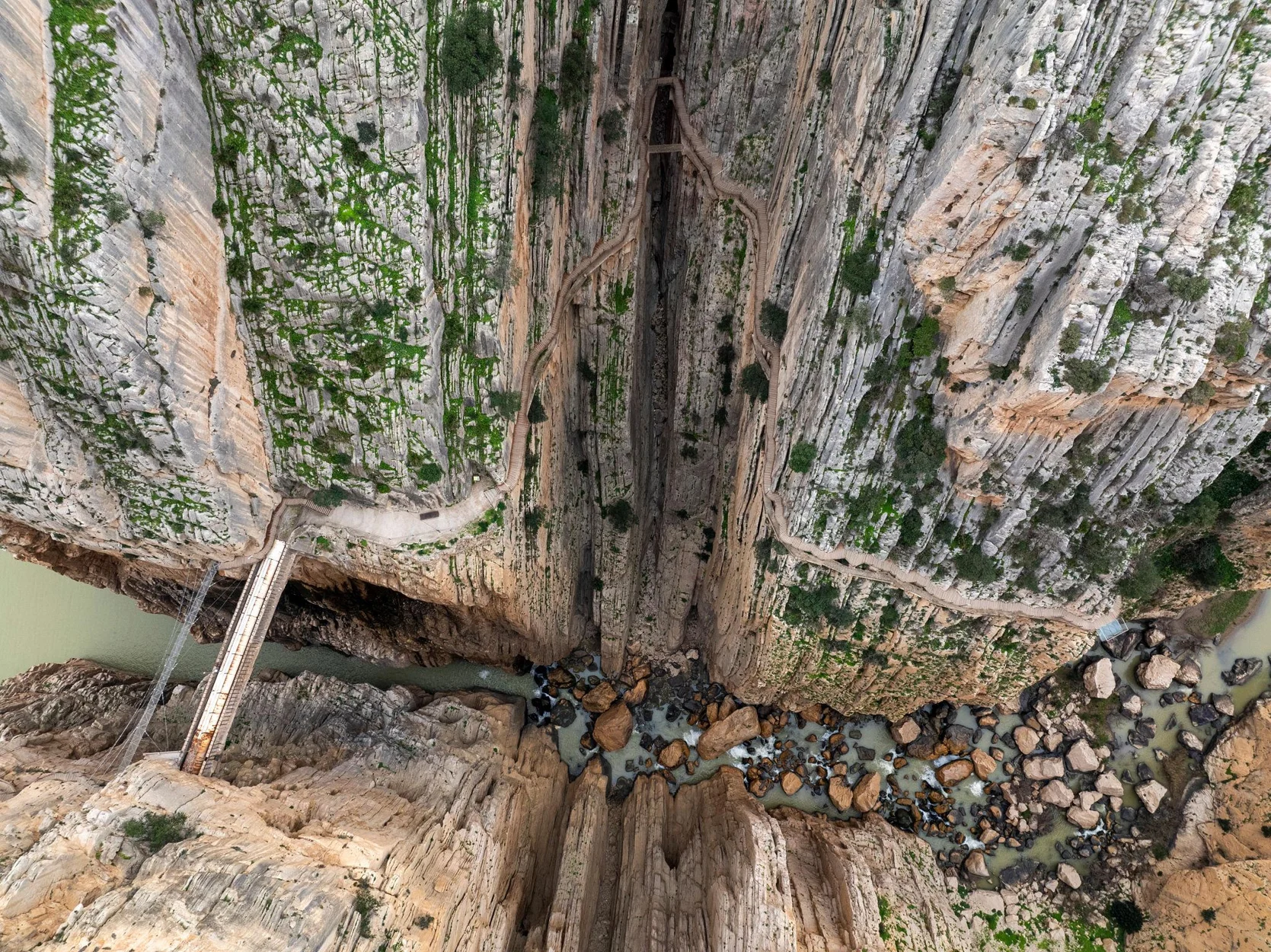 The gorge and the crossing above the Guadalhorce.
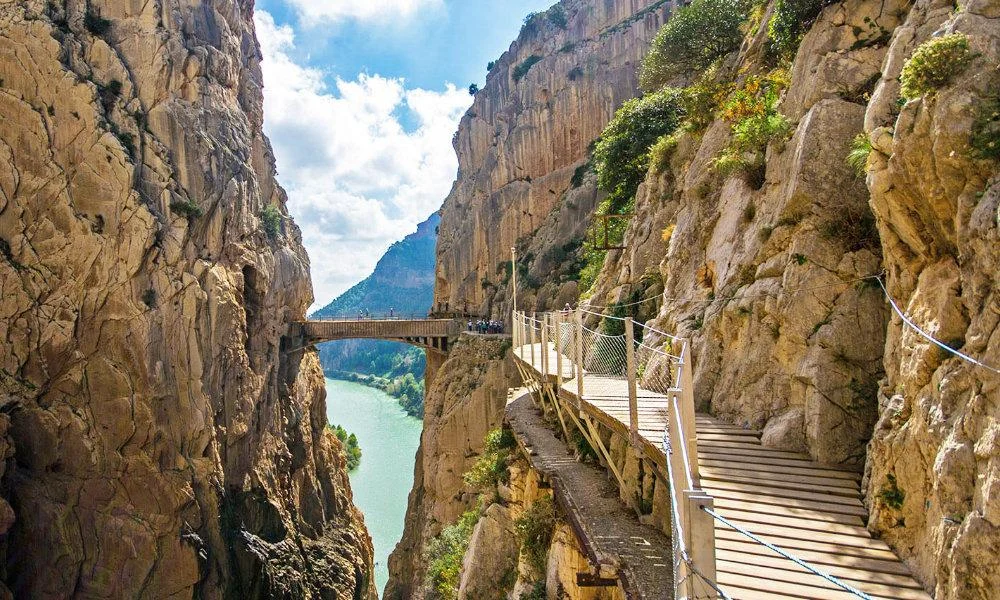 The wooden walkway follows the cliff face.
From above, the gorge looks almost too narrow to admit a river. Find the suspension bridge in the photograph, then trace the thin line of boards back along the wall. At walking pace that line becomes a succession of corners: cool shadow against your shoulder, a glimpse of water between the boards, then a turn that opens the whole ravine ahead.
“I’m looking forward to the view on the Caminito. I’d just prefer it to stay in front of me, where views belong.”
Back to contentsGranada & the Alhambra · February
The palace that outlived its kingdom
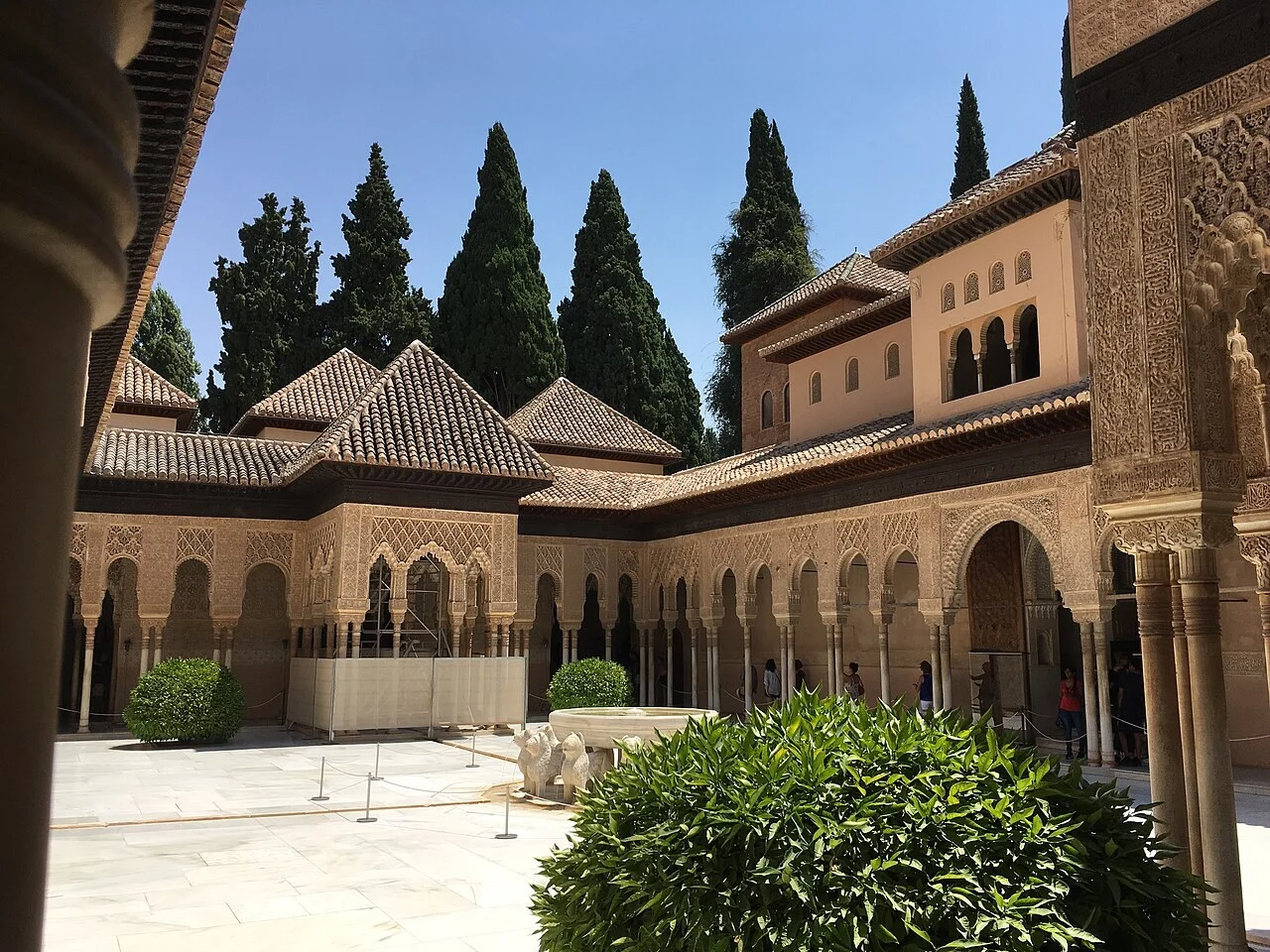 Water channels cross the Court of the Lions at the Alhambra. · Heparina1985 · CC BY-SA 4.0
In the Court of the Lions, the detail to follow is underfoot. Narrow channels run through the marble towards the fountain. Raise your eyes and the columns seem almost too slight to hold the arcade above them. Muhammad V commissioned this palace in the fourteenth century, when Granada was still the seat of a living Nasrid court. Rooms like these were built for an audience who expected the dynasty to endure.
On 2 January 1492, Muhammad XII, known in Spain as Boabdil, surrendered Granada to Isabella of Castile and Ferdinand of Aragon. The handover ended the last Muslim-ruled kingdom on the Iberian Peninsula. It is the event conventionally used to close the Reconquista. For the people living below the palace walls, the date marked a change of rulers. The upheavals over faith and belonging would continue for generations.
The victors kept the Alhambra as a royal residence. Later, Charles V commissioned the Renaissance palace that stands beside the Nasrid rooms. Walk from the fine columns of the Court of the Lions to the massive circular courtyard of his palace and the contrast is startling. The two courts survive within a few minutes’ walk of each other. That makes Granada an unusually vivid place to read what conquest changed, and what the new rulers chose to keep.
Imagine the questions after the surrender. Would the peace last? Would the old rulers return? And what would happen to lunch?
After all, you can change the rulers, tear down the banners and rewrite the history books, but nobody wants to lose a perfectly good lunch.
Centuries later, the Spanish were still cooking rice with saffron — two ingredients deeply connected to the agricultural legacy of Al-Andalus. Apparently, some things were simply too bloody delicious to reconquer. Rice cultivation and the use of saffron have deep Andalusi connections. Modern paella developed much later.
“Would the bloke selling spiced lamb on a stick still be there on Tuesday?”
Back to contentsCórdoba · February
Under the striped arches
Row upon row of striped arches leads the eye across the former prayer hall of the Mezquita-Catedral. Keep walking and the space changes around you until a cathedral rises inside the mosque.
“I can already picture myself trying to count the arches and giving up somewhere around lunch.”
Back to contentsSeville · February
Seville
Beside the Guadalquivir, the Royal Alcázar, the cathedral and the Giralda tell the story of Seville in three different voices. There’s time in that conversation for tapas.
“I’ve given myself a day between the palace and the cathedral. The tapas bars may appeal that ruling.”
Back to contentsPorto · February
From tiled battles to the boats that paid the bills
Have coffee and a pastry at Bolhão. Give Jorge Colaço’s tile panels at São Bento a proper look, then walk up to the Sé and across to Clérigos. The station shows how twentieth-century Porto chose to tell an older national story. Lunch at Café Santiago puts a different century on the table in the form of a francesinha.
Cross the Dom Luís I Bridge to Jardim do Morro for the evening light. Add Palácio da Bolsa if the timings fit.
“The views across Porto were breathtaking. The scenery was to die for — and, historically speaking, quite a few people did. They fought and died during the Siege of Porto. I, meanwhile, have come armed with a bifana, a phone full of storage and an entirely unreasonable number of selfies.” — Paul Cook. This is a proposed quote, not locked until the user approves. Prefer the Serra do Pilar historical framing to an unqualified claim that the Dom Luís I Bridge itself was a siege site: the present bridge postdates the siege. PORTO EDITORIAL QUOTE — REVISED WITH RECONQUISTA SANDWICH JOKE (22 NOV 2026) User enthusiastically accepted the Porto siege/bifana quote and requested an extra line about having conquered one sandwich and considering a Reconquista for another. Preferred revised text: “The views across Porto were breathtaking. The scenery was to die for — and, historically speaking, quite a few people did. They fought and died during the Siege of Porto. I, meanwhile, have come armed with a bifana, a phone full of storage and an entirely unreasonable number of selfies. Having successfully conquered my first bifana, I now face a dilemma worthy of the great military strategists: do I declare victory and withdraw, or launch a Reconquista and take a second sandwich?”
Back to contentsCoimbra · February
Through the old city gate to a king’s cathedral
Inside the Joanina Library, look for João V’s portrait among the gilded shelves. Down by the Mondego, a bowl of caldo verde and some bread sound about right.
“A library with bats and a lunch with crackling. Coimbra has made a surprisingly strong case for higher education.”
Back to contentsLisbon · February–March
Walk into the footprint of a lost palace
Start at Praça do Comércio. For a Roman thread, book the archaeological visit under Rua dos Correeiros, then buy sardines and bread near the waterfront. Give Belém a morning of its own: Jerónimos cloister, then a warm tart at Pastéis de Belém, where the bakery dates production to 1837 and traces the recipe to the monastery.
Order bacalhau à Brás for lunch, or take a bifana from As Bifanas do Afonso on a Baixa walk. Finish via the Sé and Alfama at Portas do Sol. Add Carmo or the castle if time allows.
“I’ll walk up Lisbon’s hills for the history. I’ll walk back down for another custard tart.”
Back to contentsIstanbul
The emperor in the grandstand
Start in Sultanahmet with simit, white cheese, olives and tea. Walk the line of the old Hippodrome before looking up at Hagia Sophia. One space held the crowds of the Roman capital; the other lets you see what successive empires kept and changed.
“I can see myself losing track of the centuries inside Hagia Sophia and finding my bearings again at a simit cart.”
Back to contents